
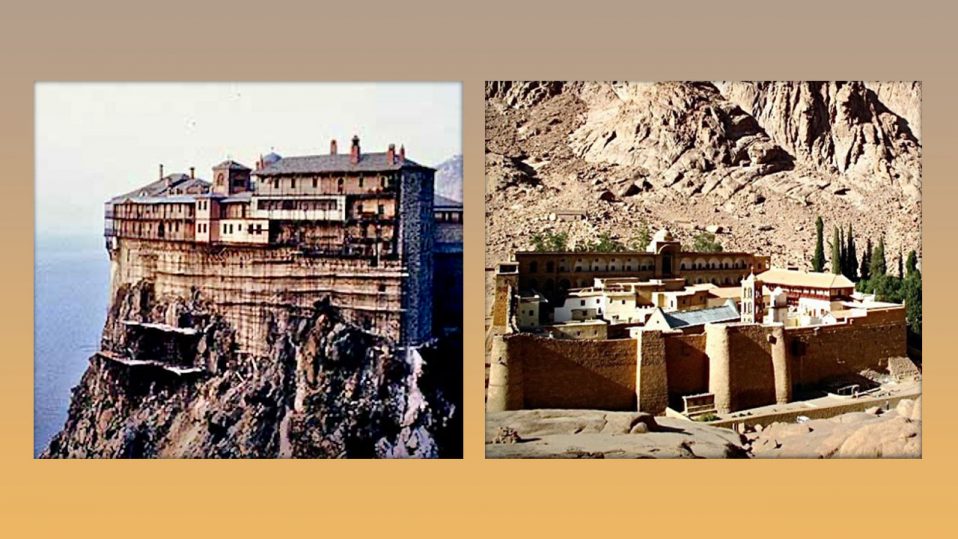
Join us the EMBCA’s “The Status of Orthodox Monasteries under Islamic Rule- and Why This Still Matters and Important “ webinar panel discussion on Sunday, February 22, 2026 at 2 P.M. EST / 9 P.M. Athens EEST. The panel discussion will be introduced and moderated by Lou Katsos, EMBCA’s President. Our distinguished panel will include Prof. Dr. Johannes Niehoff- Panagiotidis of the Freie Universitat Berlin; Prof. Dr. Theocharis N. Gregoriadis of the Freie Universitat Berlin; Istanbul -based Legal Professional and Researcher Ali Emre Desat; Jurist Dr. Anastasios Nikopoulos Law historian at the Freie Universität Berlin; and Academic Researcher and PhD Candidate in Byzantine Studies at the Freie Universat Berlin Rahime Aksa Boyraz. They will be joined by Sayed Kamel Mirkhalaf.
For centuries, Orthodox monasteries and Christian institutions across the Eastern Mediterranean survived, and often flourished, under Islamic rule. Their endurance was not accidental, but rooted in a distinctive legal and economic framework that granted them protection, continuity, and a measure of autonomy within Islamic law.
Central to this system was the institution of waqf (vakıf in Ottoman Turkish), a form of charitable endowment that rendered property legally inalienable. While primarily associated with Islamic foundations, waqf arrangements also extended through custom, decree, and negotiated privilege to Christian monasteries and communal institutions. For Orthodox monastic communities, this status ensured remarkable stability: land could be held, income generated, and religious and communal life sustained across centuries of political change.
These monasteries were not isolated spiritual enclaves. They functioned as economic and social anchors, supporting agriculture, education, charity, and local employment. In many regions, monastic estates preserved economic continuity and social cohesion more effectively than later modern systems would allow.
The decisive rupture came not with conquest, but with the rise of the nation state. As nineteenth century successor states replaced imperial governance with centralized legal authority, inherited waqf based arrangements became increasingly difficult to reconcile with modern property law and fiscal systems.
This tension was already evident in the early Hellenic state. Ioannis Kapodistrias, tasked with building new institutions on land long governed by Ottoman law, confronted unresolved questions of ecclesiastical property, ownership, and jurisdiction. Similar challenges emerged across the former Ottoman world, and persist today from Mount Athos and Mount Sinai to the long-running disputes surrounding Mor Gabriel Monastery in Turkey.
These cases are not only about religious freedom or historical legacy. They are also economic issues. Legal uncertainty over monastic property affects land use, investment, tourism, employment, and regional development. Monasteries remain major custodians of cultural heritage and productive landscapes; when their legal status is contested, economic stability suffers.
Reexamining the status of Orthodox monasteries under Islamic rule is therefore not an exercise in nostalgia. It is an inquiry into how legal continuity, historical legitimacy, and economic sustainability intersect in the modern world. The unresolved legacy of waqf arrangements continues to shape political relationships, minority rights, and economic planning.
Understanding this past allows us to approach present challenges with greater clarity. Economies depend not only on markets and capital, but on predictability, trust, and legal coherence. Where historical realities are ignored, instability follows. Where they are intelligently integrated, continuity becomes a foundation for sustainable growth.
Join us for a timely discussion featuring experts and scholars who will examine the status of Orthodox monasteries under Islamic rule, its lasting significance, and the challenges and opportunities moving forward.

EMBCA is an organization exempt from Federal Income Tax under Internal Revenue (IRC) Section 501(c)(3), classified as a public charity, and qualifies to receive tax deductible bequests, devises, transfers or gifts under Section 2055, 2106, or 2522 . Donors can deduct contributions they make under IRC Section 170. Thank you all again for your continuing enthusiasm and support of our events !!