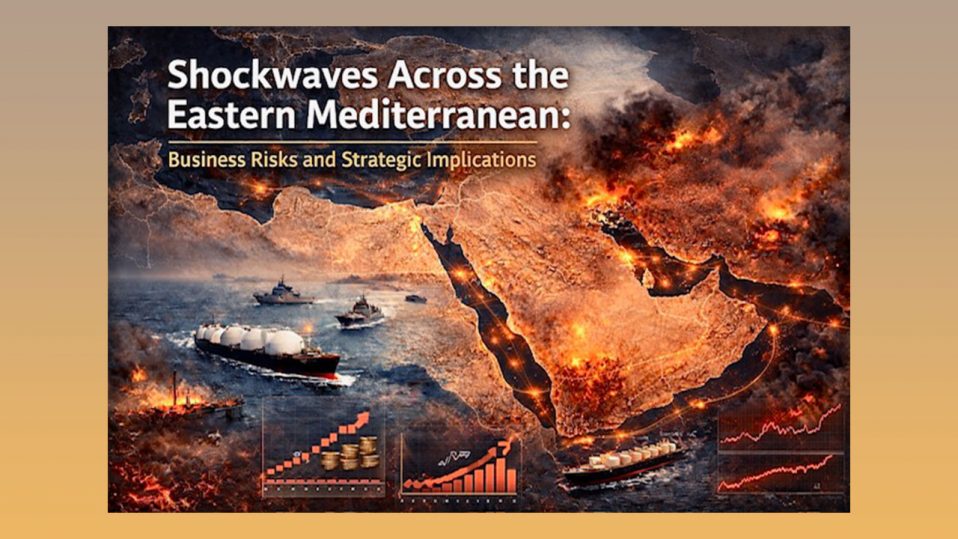
Join us for EMBCA’s “Shockwaves Across the Eastern Mediterranean: Business Risks and Strategic Implications” webinar Panel Discussion on Sunday, March 29, 2026 at 2 P.M. EST/ 9 P.M. Athens EEST. The panel discussion will be moderated by John E. Katsos, Visiting Professor at Kelley School of Business at Indiana University and Nobel Peace Prize Nominee. The distinguished panel will include Scott Wilcox, Senior Advisor - Risk & Decision Support | Founder, Sicuro Group; Laury Haytayan, MENA Director at Natural Resource Governance Institute Natural Resource Governance Institute at the University of Exeter; and Jay Joseph, Assistant Professor, Business and Peace, Director, Business-in-Conflict Research Group at the American University of Beirut.
The recent Israeli and American military strikes on Iran, followed by Tehran’s retaliatory actions, have sent shockwaves far beyond the immediate conflict zone. While the military dimension has dominated global headlines, the secondary effects are already reverberating across the Eastern Mediterranean and broader Near East, regions where geopolitics, energy security, and commerce have long been closely intertwined.
For businesses operating in the Eastern Mediterranean basin, the consequences are unfolding in real time. In Lebanon, rising instability has triggered troop movements and new waves of displaced civilians, raising concerns about humanitarian pressures, border security, and the resilience of fragile state institutions. At sea, key maritime corridors linking the Levant, the Suez Canal, and European markets are experiencing heightened military surveillance and coordination among regional powers including Cyprus, Turkey, and Greece, complicating shipping operations and logistical planning.
Energy markets are also responding rapidly. Over the past two decades, the Eastern Mediterranean has emerged as an important frontier for natural gas exploration and regional energy cooperation. Escalating tensions now raise questions about the security of offshore infrastructure, pipeline development, and the durability of regional energy partnerships, while contributing to broader volatility in global oil and gas markets.
The maritime sector, long shaped by the strategic adaptability of Greek shipping, once again finds itself navigating a shifting geopolitical landscape. Greek shipowners, who control one of the world’s largest merchant fleets, are already adjusting routes, insurance coverage, and chartering strategies as war-risk premiums rise and security measures tighten across regional ports and waterways.
At the same time, supply chains are under increasing pressure. The Eastern Mediterranean serves as a critical transit zone linking Europe with the Middle East, Asia, and North Africa. Prolonged instability could disrupt flows of energy, commodities, and manufactured goods moving through major ports from Haifa to Piraeus, forcing firms to reassess logistics, risk management, and investment strategies.
This virtual panel will bring together leading experts in geopolitics, maritime commerce, energy markets, and regional security to examine how the strikes and their aftermath are reshaping the business environment across the Eastern Mediterranean. Panelists will assess near-term operational risks facing firms in shipping, energy, logistics, and finance, while also exploring the broader strategic implications for trade routes, regional cooperation, and investment flows.
At a moment when the Eastern Mediterranean again stands at the intersection of great power rivalry, regional conflict, and global commerce, understanding these dynamics is essential for business leaders and policymakers navigating an increasingly complex regional order.
EMBCA is an organization exempt from Federal Income Tax under Internal Revenue (IRC) Section 501(c)(3), classified as a public charity, and qualifies to receive tax deductible bequests, devises, transfers or gifts under Section 2055, 2106, or 2522 . Donors can deduct contributions they make under IRC Section 170. Thank you all again for your continuing enthusiasm and support of our events !!