
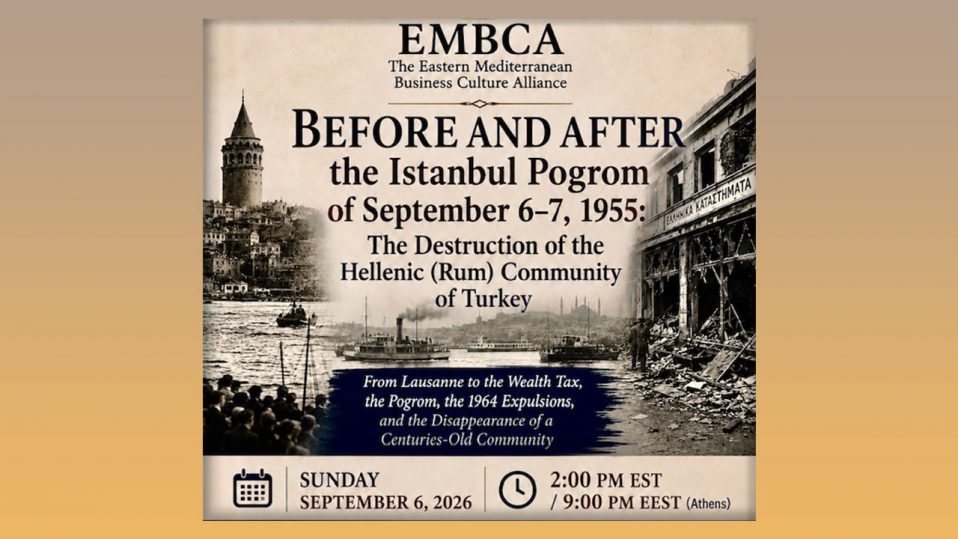
Join us for EMBCA’s “Before and After the Istanbul Pogrom of September 6-7, 1955: The Destruction of the Hellenic (Rum) Community of Turkey “ on Sunday, September 6, 2026 at 2 PM EST/ 9 PM Athens EEST. The discussion will be introduced and moderated by Lou Katsos, President of EMBCA. Our distinguished panel will include Dr. Alexandros K. Kyrou, Professor of History and Director of the Program in East European and Russian Studies at Salem State University; Dr. Konstantinos Tsitselikis , Professor of Human Rights and International Organizations at the University of Macedonia; Dr. Elizabeth H. Prodromou Professor in the International Studies Program at Boston College; Prof. Dr. Johannes Niehoff- Panagiotidis of the Freie Universitat Berlin; Dr. Harry G. Dimopoulos, International Businessman and 1955 Pogrom Survivor; and Stelios Taketzis, Producer and former Executive Director of COSMOS FM.
At the time of the Treaty of Lausanne (1923), approximately 100,000 Greeks remained in Constantinople, representing roughly 12–15% of the city’s population. Today, only an estimated 1,500–2,500 members of the historic Rum community remain in a metropolis of nearly 16 million—approximately one-hundredth of one percent of the population. This dramatic demographic collapse was not accidental, but the result of decades of discrimination, economic pressure, violence, and forced emigration.
The discussion will place the Pogrom within the broader context of the Wealth Tax (Varlık Vergisi) of 1942, discriminatory legislation, property confiscations, restrictions on minority institutions, administrative harassment, and the 1964 expulsions, all of which accelerated the decline of a community that had flourished in Constantinople for nearly seventeen centuries and in Asia Minor for more than three millennia.
The attacks were incited by false reports alleging that Greeks had bombed the Turkish Consulate in Thessaloniki, the birthplace of Mustafa Kemal Atatürk. It was later established that the bomb had been planted by a Turkish employee of the consulate. The fabricated story became the pretext for a carefully organized assault in which tens of thousands were transported into Istanbul while municipal vehicles distributed tools used to systematically attack Greek homes, businesses, churches, schools, cemeteries, and community institutions.
Approximately 4,214 Greek homes, 1,004 businesses, 73 churches, two monasteries, and 26 Greek schools were damaged or destroyed. Between 13 and 16 Greeks, including two Orthodox priests, and one Armenian lost their lives, while countless others were assaulted. Armenian and Jewish properties were also attacked. Estimated losses reached $500 million (1955 U.S. dollars), while only limited compensation was ultimately provided.
A central theme of the discussion will include the Treaty of Lausanne, whose provisions guaranteed Turkey’s non-Muslim minorities equality before the law, religious freedom, property rights, and the protection of their educational, religious, and charitable institutions. The panel will examine how these internationally guaranteed protections were progressively eroded through discriminatory taxation, legislation, organized violence, confiscations, and expulsions, fundamentally transforming the demographic and cultural landscape of one of the world’s oldest Hellenic communities.
Beyond recounting the events, the discussion will explore broader issues of minority rights, religious freedom, cultural heritage, international law, historical memory, restitution, and justice. It will ask not only what happened, but why it happened, how one of history’s oldest Hellenic communities was reduced to a tiny remnant, and what lessons this history offers for protecting vulnerable minorities today.
Join us for an important panel discussion examining the Istanbul Pogrom of September 6–7, 1955, one of the defining tragedies of modern Hellenism, and the systematic policies that led to the near destruction of Turkey’s indigenous Hellenic (Rum) community.

EMBCA is an organization exempt from Federal Income Tax under Internal Revenue (IRC) Section 501(c)(3), classified as a public charity, and qualifies to receive tax deductible bequests, devises, transfers or gifts under Section 2055, 2106, or 2522 . Donors can deduct contributions they make under IRC Section 170. Thank you all again for your continuing enthusiasm and support of our events !!