
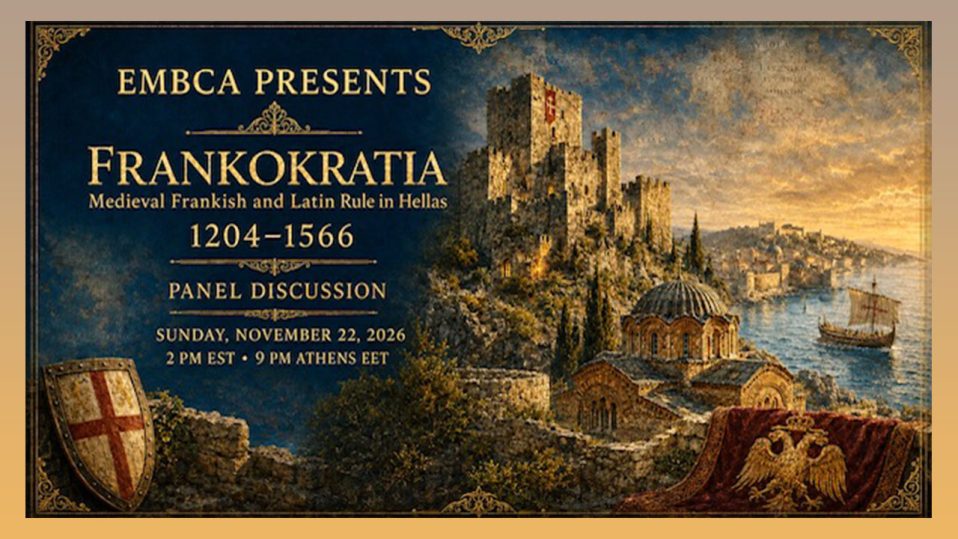
Join EMBCA for “Frankokratia: Medieval Frankish and Latin Rule in Hellas, 1204–1566”, a Webinar Panel Discussion on Sunday, November 22, 2026, at 2 PM EST / 9 PM Athens EET. The discussion will be introduced and moderated by Lou Katsos, President of the East Mediterranean Business Culture Alliance (EMBCA). Our distinguished panel, currently in formation, will include Prof. Dr. Johannes Niehoff- Panagiotidis of the Freie Universitat Berlin; and Author and Historian Dr. Constantine G. Hatzidimitriou.
The Fourth Crusade’s sack of Constantinople in 1204 fractured the East Roman/ Byzantine world, establishing a Latin Empire and opening the way for Western lordships across mainland Greece and the islands. Known broadly as Frankokratia, this period encompassed competing principalities, Byzantine resistance, and shifting alliances and not a single, uniform occupation. Latin rule continued in many territories after Constantinople’s recovery in 1261.
From the Villehardouin Principality of Achaea in the Morea to the Duchies of Athens and the Archipelago, the panel will explore how conquest, dynastic ambition, and maritime commerce reshaped the Hellenic world. Castles such as Chlemoutsi and the changing fortunes of Mystras reveal the overlapping legacies of Frankish power and Byzantine renewal.
An important lens is the Chronicle of the Morea (Το Χρονικόν του Μορέως), a fourteenth century narrative surviving in Greek, French, Italian, and Aragonese versions. Its vernacular Greek verse recounts conquest, feudal society, and princely rivalries. Blending history with heroic storytelling and political justification, it illuminates both medieval life and the contested memories of rulers and ruled.
The discussion will also examine the Orthodox Church under Latin authority, relations between religious communities, and the experiences of merchants, landowners, clergy, and rural populations. Resistance, accommodation, and cultural exchange will frame consideration of how communities preserved and adapted their traditions.
The endpoint of 1566 marks the replacement of Naxos’s last Latin Christian duke under Ottoman authority, rather than the universal end of Western rule; Venetian possessions followed different chronologies.
Through history, literature, and surviving monuments, the discussion will illuminate a consequential era of conflict and encounter whose legacy remains embedded in the landscapes and cultural memory of Hellas.

EMBCA is an organization exempt from Federal Income Tax under Internal Revenue (IRC) Section 501(c)(3), classified as a public charity, and qualifies to receive tax deductible bequests, devises, transfers or gifts under Section 2055, 2106, or 2522 . Donors can deduct contributions they make under IRC Section 170. Thank you all again for your continuing enthusiasm and support of our events !!